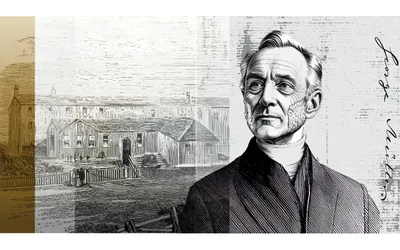


This address was delivered by George Müller at a conference of Christians of various denominations held at Clifton, Bristol, England, on September 30, 1873. He was one of many speakers at the conference.
Considered the most romantic book of the Bible, Song of Songs is meant to highlight the goodness of physical love and intimacy within marriage, emphasizing that it's a reflection of God's love for His people. It is called a love story that celebrates the relationship between a man and a woman, mirroring God's relationship with humanity. Song of Songs is also considered an analogy of the relationship between believers and the King of kings, which is intensely personal but never private.
A garden enclosed is my sister, my spouse, a spring shut up, a fountain sealed. Your plants are an orchard of pomegranates with pleasant fruits, fragrant henna with spikenard, spikenard and saffron, calamus and cinnamon, with all trees of frankincense, myrrh and aloes, with all the chief spices—a fountain of gardens, a well of living waters, and streams from Lebanon. Awake, O north wind, and come, O south! Blow upon my garden, that its spices may flow out. Let my beloved come to his garden and eat its pleasant fruits. (Song of Songs 4:12-16, NKJV)
What I have to say this evening, beloved Christian friends, is in connection with the first portion of Holy Scripture to which our attention has been directed, contained in the Song of Solomon. Though it is not necessary to repeat what God’s object is in giving to us the Song of Songs, it should be in our hearts to seek to enter into the spiritual meaning of this most precious book. I do not know one single part of divine testimony that more adequately acts like a spiritual thermometer to show how it is regarding our affection for the Person of our worthy Lord Jesus Christ than this little portion of the Word of God called the Song of Songs. And this portion to which our attention is directed for consideration in these meetings, if entered into concerning ourselves, may bring an abundant blessing to our souls.
Now, let us once more read this verse, and, as God may help me, I desire to make a few remarks. “A garden enclosed is my sister, my spouse"; we are called a "spouse," the most intimate of all relationships. How did it happen that we are in this most intimate of all relationships? It’s because of that deep sleep of death that fell upon Jesus. That blessed One died in our place so that we might have life, so that we might be brought into this most intimate of all relationships with Him, so that we should be His bride. Now, this sister is called a “garden enclosed,” "a spring shut up," and "a fountain sealed"; these three different images are used. Let me say here that how I judge the meaning is not what is commonly stated. The very word "garden” implies that it is partitioned, a portion of land taken away from the rest, sometimes surrounded by a hedge or wall, or in some other way enclosed and cultivated. It is this very thing that causes it to be a garden. But it is not simply a garden; there is something added regarding the garden, and that is that it is "barred," "bolted" and "shut up," just like this spring and this “fountain sealed"; we must grasp this idea! Not that this portion of land is enclosed, but that this enclosed field is shut up—it is not accessible to everyone. The owner goes in and out as he pleases; he has a right to this piece of land, to this garden—but it is bolted, it is barred, it is shut up, and it is not accessible to everyone.
Just as he who sealed the fountain may alone break the seal, and he who shut up the spring may remove that by which it is shut up and may partake of the refreshing water from this fountain, so may we let the Lord do the same in us. What is meant by this imagery of "a bolted garden," "a spring shut up," "a fountain sealed"? We are our Lord's property—He has bought us with His precious blood; thus, we are His and not our own. The right to the garden is His, the bolts and keys are His, the fountain is His, the spring is His; all belong to that blessed One who bought us with His precious blood! Do we feel in our inmost souls that all we have and are belong to the Lord? That He has bought us, our talents, and our time? Do we feel that He has bought our eyes, our hands, our feet? Do we feel that our houses and property, our horses and carriages, belong to Him? That all the money we have is His—our profession, our business—that everything we have and are is His? Oh! If our inmost souls truly believed this, what Christian men and women should we be from this time and from now on!
Now, beloved in Christ, we have come here not to pass an hour or two for amusement, but instead that our inmost souls may be affected and that we may be more holy and devout, completely consecrated to the Lord. Let us seek to enter into this glorious fact, that the Lord Jesus Christ has bought us with His precious blood, that we are absolutely His and not our own—and not for the duration of this conference, but for all the days of our lives; we, and all that we have and are, belong to the Lord. Oh! Let us ask God to write this upon our hearts and to seal it so that from this evening onward we shall never be able to lose sight of this truth! This, I judge, is the great main message that the Holy Spirit wants to bring before us. Now we read the next verse:
Your plants are an orchard of pomegranates with pleasant fruits, fragrant henna with spikenard, spikenard and saffron, calamus and cinnamon, with all trees of frankincense, myrrh and aloes, with all the chief spices.
What is this? The Lord Jesus coming into His garden and the grace He sees in His Church—the grace He sees in His Bride, His sister: the Bridegroom is able to take delight and joy and pleasure in what He sees in His people! Beloved in Christ, the question to ask is this: Is this true of me? When I was meditating upon this portion last Sunday evening, I said to myself, “Lord, let it be so with me; help me so it may be thus with me.” Oh, that it may be thus with ourselves, individually, so that it isn’t just “now and then," when we are under special spiritual influences or under special spiritual excitement, such as the present may be; but that day by day, from Monday morning until Saturday evening, and all day long, all week long, all year round, we may be in the fear of the Lord.
It is just this which, with the blessing of God, will make an effect upon the consciences of the unconverted. When they see that we are sincere, that there is a reality about our profession as disciples of the Lord Jesus Christ. When they can say, “Look at that disciple; he or she is just what he or she was twenty, thirty, or forty years ago," and so goes on that man or woman—day by day, week by week, month after month, and year after year—always in the fear of God, always setting Christ before themselves. Oh, if it were this way with us, beloved in Christ, what a testimony our lives would be to an ungodly world! More than this, think how that would strengthen each other's hands in God!
We are all members of the Body of Christ, and each of us has a role to perform to help our fellow believers. We should not be simply satisfied with reading that Jonathan went into the woods to strengthen the hands of David (see 1 Samuel 23); but we should ask ourselves, “Do I strengthen my brothers and sisters? Do I lend them a helping hand when they are being tried and afflicted and weak? When they are falling, do I seek to strengthen their hands in God?” In 1 Thessalonians 5:11, we read, “Therefore encourage one another and build each other up, just as in fact you are doing.” Do we build up one another, seeking to encourage and lead one another in the knowledge of Christ? How is it with us regarding these points? Is it true of us that we are not merely plants and trees, but fruit-bearing trees in the Lord's garden?
Oh, beloved in Christ, are our daily lives and walks a sweet perfume to Christ? Let us ask ourselves and deal honestly with our souls this evening. Before we go away, let us ask ourselves, as if before God, the question, "Is my life and my behavior a sweet aroma to Christ? Do I refresh the heart of my blessed Lord?” May it be so, beloved in Christ! Oh, let this be our goal; and if we honestly ask the Lord for His help, we should most assuredly experience the fulfillment of the promise of the blessed Lord Jesus, found in Matthew 13:12: “Whoever has will be given more, and they will have an abundance.” And we should truly experience the truth of the precious statement of the apostle Paul, “I can do all things through Christ who strengthens me” (Philippians 4:13, NKJV).
Song of Songs continues, “A fountain of gardens, a well of living waters, and streams from Lebanon” (verse 15). The Lord Jesus Christ further says this about the Church: She is a fountain of gardens, meaning a fountain such as is found in a garden. “A well of living waters, and streams from Lebanon." The takeaway, I think, that is meant to be conveyed as to the spiritual meaning is this: the refreshing that is intended to be diffused through the instrumentality of the Church. You remember well that statement in the Gospel of John regarding the Spirit not yet given, “Anyone who believes…‘Rivers of living water will flow from his heart’” (John 7:38, NIV). The Church should be a fountain—a spring of living waters—a spring running from Lebanon. How does this apply to us? If we ask ourselves, as if we were before God (and we should always deal honestly with our hearts), we should ask, “Is the living water flowing out of me? Am I God's instrument of spiritual blessings? Do I, by my life, actions and words, minister by the Spirit to others?” How often do we seek to do this? Do we think of it at all? Do we act on it constantly?
What the Lord Jesus Christ looks for is this: Since He has graciously been pleased to give unto us the Holy Spirit, it should be true of us individually “that out of us flow rivers of living water.” And I would say that if we expected it more, we should have more; and if our life and walk and actions were more reflective of a disciple of the Lord Jesus, we should, by the grace of the Spirit, refresh others, and out of us would truly flow rivers of living water, as was the case in the days of the apostles. The authority of the apostles we cannot have; and if any were to come and tell us that they were apostles, we should at once say that they were liars. But while we cannot have the authority of the apostles, we should seek after the grace the apostles had. It may be true of the saints of the Most High now in this latter part of the nineteenth-century, as it was true of them in the days of Paul, that out of them flowed rivers of living water. And if, beloved in Christ, we were expecting this and were praying for this, then we might be men and women out of whom should flow rivers of living water, and we would truly find out that the Lord is true to His Word and that He would give us help and strengthen us so it might be so.
The last verse says, “Awake, O north wind, and come, O south! Blow upon my garden, that its spices may flow out.” It’s possible that the way I understand this verse may differ from how others might understand it. The meaning, as I interpret it, is this: the Church responding and delighting to give joy to the heart of her beloved Bridegroom. The Church, wishing to refresh Him by her sweet perfumes and pleasant fruits, says, “Awake, O north wind, and come, O south! Blow upon my garden, that its spices may flow out. Let my beloved come to his garden and eat its pleasant fruits.” I understand the whole of this verse, and not simply the last words of it, is to be a statement of the Church: the beloved is speaking to the bridegroom in order to refresh his heart, and so the saints of the Most High should always look to Him and say to themselves, "How can I give joy to the heart of my blessed Lord? He has laid down His life for me, so what can I do for Him? How can I serve and glorify Him?” And if any should say, “I am poor,” or “I am young,” or “I have not much learning; I have been but recently brought to the knowledge of the Lord,” I say to them, “Everyone who is a believer in the Lord Jesus Christ and a recipient of the Holy Spirit, reborn and renewed, has it in his heart to refresh and gladden the heart of the Lord Jesus Christ.
Oh, let us never say, “I can do nothing to give joy to the heart of my blessed Lord.” We can do it! And the Lord Jesus Christ looks for it that we should do it. He has given the last drop of His blood for us and went through everything necessary for our salvation; and now He is looking that we, on our part, seek His glory and refresh His heart in return for all He has done for us. And thus it comes that the Church desires to gladden the heart of the Lord Jesus, and she says, “Let my Beloved come into His garden and eat His pleasant fruits.” Now, notice the response of the blessed One in the first verse of the next chapter:
I have come to my garden, my sister, my spouse; I have gathered my myrrh with my spice; I have eaten my honeycomb with my honey; I have drunk my wine with my milk. Eat, O friends! Drink, yes, drink deeply, O beloved ones! (Song of Songs 5:1)
The first thing I notice here, in particular, is the possessive pronoun “my” because we belong to the Lord and have nothing in ourselves. It is “my spice,” “my garden,” “my honeycomb,” “my honey”—everything belonging to the Lord Jesus. And this we must never lose sight of: however much we may be advanced in knowledge and grace, we owe every particle of grace and knowledge to the Lord. We must never stand before a spiritual mirror and think of what we have done or what we have attained, but instead give all the honor and glory (not in word only, for that is a little thing, but in our inmost souls) to Him to whom it is alone due! The Lord Jesus Christ claims it all for Himself. It is “my garden,” “my sister,” “my spouse,” “my myrrh,” “my spice,” “my honeycomb,” “my honey”—everything belongs to Him.
And then at the close of the verse, “Eat, O friends! Drink, yes, drink deeply, O beloved ones!” Perhaps it should say, “Be satisfied in love," or at least I interpret it that way. And here let me say particularly, if there is one thing more than another after which we should aim, it should be an increase of love. Oh, when we think of it, that there is a possibility of being satisfied in love, what a blessed, blessed, blessed thing to set before us, to be aiming after this, to be happy in love, to be filled with love. Oh, beloved in Christ, let it be our holy, godly aim to know something of this for ourselves!
And may these blessed meetings be a great encouragement for our goal to go after an increase of love. That is one of the special reasons why we come together: not so much that we may instruct one another, but that we may spur one another to grow in an increase of love. Oh, let us aim for this! God is love. And just in measure as we are helped to grow in love, so, and only in so far, do we become more like God.








.png) George Müller
George Müller