

George Müller preached this sermon at Bethesda Chapel, Great George Street, Bristol, England. It was given on a Thursday evening, March 3, 1870, after the death of his wife. Originally given on a Sunday, it seems he repeated the sermon another day, as upwards of 800 people were unable to enter the building to attend.
You [the Lord] are good, and what you do is good. (Psalm 119:68, NIV)
The reason why I intend to preach this funeral sermon is not because the late Mrs. Müller was my beloved wife, nor that I might have an opportunity of speaking highly of her—most worthy though she is of it—but it is so I may magnify the Lord in giving her to me, in leaving her to me so long, and in taking her from me to Himself.
She was the first member of the church when it was formed in August 1832, and her whole life ever since then has been of the most blameless character; her life was full of the most remarkable and instructive events. At the departure of such a Christian, we should ponder the lessons that her life shows us. Throughout her church life, she saw 2,700 believers join the church, of which she was the first; and when she died, there were 920 in the church, with about 1,500 having either died or left Bristol, 200 of the believers joining with other churches in Bristol, and 90 having been put out from fellowship.
During the last six days that my beloved wife was on earth, my soul was sustained by the truth contained in the words of our text: You, Lord, are good. Whether she had relief from pain or was in severe pain, whether there was a little prospect that she might yet recover, or whether all hope was gone, my soul was sustained by those words. They were ever present with me, and I rested my soul on them. When it pleased God to take my darling wife to Himself, my soul was so sustained by them, so much so that if I had gone out that evening to preach, I should have preached from them. I desire now, as God may help me, for the benefit of my fellow Christians, particularly, to dwell on the truth contained in these words, with reference to my beloved departed wife:
First, the Lord was good and did good in giving her to me.
Second, He was good and did good in giving her for this long.
Third, He was good and did good in taking her from me.
In bringing her into my life, I clearly see God’s hand at work—no, His hand was unmistakably present. And from the depths of my heart I say, “Lord, You are good and all You do is good.” I refer to a few particulars for the instruction of others.
At the end of 1829, I left London to labor for the gospel in Devonshire. There, a brother in the Lord gave me a card containing the address of a well-known Christian lady, Miss Paget, who then resided in Exeter, so that I should call on her, as she was an excellent Christian. I took this card and put it into my pocket, but thought little of calling on her. For three weeks, I carried it in my pocket, without making an effort to see this lady; but at last I was led to do so, as it set me on the path to meet my excellent wife. Miss Paget asked me to preach on the last Tuesday in January 1830, at Poltimore, a village near Exeter, and where Mr. A.N. Groves, afterwards my brother-in-law, had preached once a month before he went out as a missionary to Baghdad. I readily accepted the invitation, as I longed everywhere to set forth the precious truth of the Lord’s return and other deeply important truths, which not long before my own soul had been filled with. On leaving Miss Paget, she gave me the address of a Christian brother, Mr. Hake, who had a boarding school for young ladies and gentlemen at Northernhay House, the former residence of Mr. A.N. Groves, so that I might stay there on my arrival at Exeter from Teignmouth. To this place I went at the appointed time.
Miss Groves, afterwards my beloved wife, was there, for Mrs. Hake had been a great invalid for a long time, and Miss Groves helped Mr. Hake in his great affliction by superintending his household matters. My first visit led to my going again to preach at Poltimore, after the lapse of a month, and I stayed again at Mr. Hake’s house; and this second visit led to my preaching once a week in a chapel at Exeter, and thus I went week after week from Teignmouth to Exeter, each time staying at the house of Mr. Hake.
All this time, my purpose had been not to marry at all, but to remain free for travelling about in the service of the gospel; but after some months, I saw for many reasons that it was better for me, as a young pastor under the age of twenty-five, to be married. The question now was—to whom shall I be united? Miss Groves was before my mind; but the prayerful conflict took some time before I came to a decision, for I could not bear the thought of taking away Mr. Hake’s valued helper, as Mrs. Hake continued to be unable to run so large a household. But I prayed again and again. At last, a decision came. I had reason to believe that I had won the affection of Miss Groves and that, therefore, I ought to make a proposal of marriage to her, however unkindly I might appear to act to my dear friend and brother, Mr. Hake, and to ask God to give him a suitable helper to succeed Miss Groves. On August 15, 1830, I therefore wrote to her, asking her to become my wife, and on August 19, when I went over as usual to Exeter to preach, she accepted me. The first thing we did after I was accepted was to fall on our knees and ask the Lord’s blessing on our intended union.
In about two or three weeks, the Lord, in answer to prayer, found an individual who seemed suitable to act as housekeeper while Mrs. Hake’s illness rendered her unable; and on October 7, 1830, we were married. Our marriage was modest. We walked to church, had no wedding breakfast, but in the afternoon had a meeting of Christian friends in Mr. Hake’s house and commemorated the Lord’s death, and then I drove off in the stagecoach with my beloved bride to Teignmouth, and the next day we went to work for the Lord. Simple as our beginning was, and unlike the habits of the world, our godly aim has been to continue ever since for Christ’s sake.
Now see the hand of God in giving me my dearest wife: First, that address of Miss Paget’s was given to me under the ordering of God; second, I finally visited her, though I had long delayed it. Third, she provided me lodging with some Christian friends, where I met Miss Groves. Fourth, when I almost decided not to propose to her, God settled the matter thus in speaking to me through my conscience— “You know you have begotten affection in the heart of this Christian sister, by the way you have acted towards her, and therefore, painful though it may be to appear to act unkindly towards your friend and brother, you ought to make her a proposal.” I obeyed. I wrote a proposal letter, and nothing but one unending stream of blessings has been the result.
Let me add a word of Christian counsel. To enter a marriage covenant is a serious matter, and it cannot be too lightly treated. Our happiness, our usefulness, and our living for God are often most intimately connected with our choice. Therefore, this choice should be made prayerfully. Beauty, age, money or mental powers shouldn’t be the deciding factor. You should wait on God for guidance and be willing to be guided by Him. Finally, true godliness, godliness without a shadow of doubt, should be the first and foremost qualification in a life companion. In addition to this, I believe this ought to be at the same time calmly and patiently weighed to determine whether in other respects there is a suitability. For instance, for an educated man to choose an entirely uneducated woman is unwise; for, however much on his part love might be willing to cover the defect, it will work very unhappily with regard to the children.
From what has been stated, I think it is plain that He who is good and does good had given me Miss Groves for a wife. Let us now see for a few moments what I had received in her as God’s gift. I mention here, as her chief excellence, that she was a truly devoted Christian. She had for her goal in life this: to live for God. We were married over thirty-nine years, and her steady purpose to live for God increased more and more. She also had a meek and quiet spirit. Those who knew her, especially those who knew her more than thirty years, saw what a very excellent Christian she was. If all Christians were like her, the joys of heaven would be found on earth far more abundantly than they are now. In her, God had been pleased to give me a Christian wife, who never at any time hindered me in the ways of God, but sought to strengthen my hands in God. And this, too, in the deepest trials, under the greatest difficulties, the service in which she helped me brought on her the greatest personal sacrifices.
From 1838-1846, we had the greatest trials of faith in the Orphan Work. Hundreds of times the necessities of the orphans could only be met by our own means, and often all our own money had to be expended; but that precious wife never found fault with me, but heartily joined me in prayer for God’s help, and with me looked out for help, and when help came, we rejoiced and often wept for joy together.
But in God’s gift to this precious woman, she was exquisitely suited to me, even naturally, by her temperament. Thousands of times, I said to her, “My darling, God Himself singled you out for me as the most suitable wife I could possibly wish to have had.” Then as to her education, she was just all I could have wished. She had had a very good and sound education, and she knew the accomplishments of a lady. She played music nicely and painted beautifully, though not five minutes were spent at the piano or in drawing or painting after our marriage. She possessed a superior knowledge of astronomy, was exceedingly knowledgeable in English grammar and geography, had a fair knowledge of history and French, and had also begun Latin and Hebrew and learned German when, from 1843 to 1845, she accompanied me in my service to Germany. All this cultivation of mind became not only helpful in the education of our daughter but was more or less used by the Lord in His service to the praise of His name. She was very good at math, which for thirty-four years was a great help to me; she habitually examined month by month all the accounts and the hundreds of bills of the matrons of the various orphan houses, and should a tradesman or one of the matrons at any time have made the least mistake, it would surely be found out by her.
But in addition to the good education of a lady, she possessed—what in our days is so rare among ladies—a thorough knowledge of useful needlework of every kind and an excellent knowledge of the quality of material for clothes, linen, etc., and thus became so eminently useful as the wife of the director of the five orphan houses on Ashley Down, where hundreds of thousands of yards of material of all kinds had to be ordered by her and to be approved of or to be rejected. My beloved wife could do fancy needlework and had done it since she was young, but she did not thus occupy her time, except that she would, with her own dear hands, now and then knit a purse for her husband while she was in the country for fresh air. Her tasks had a useful end. It was to get ready the many hundreds of neat little beds for the dear orphans, most of whom had never seen such beds, and had far less slept in them, that she labored. She busied herself to get good and proper bedding, thus serving the Lord Jesus in caring for these dear bereaved children, who had not a mother or father to care for them.
She was often seen in the homes to provide numerous other useful things in the orphan houses, and especially for the sick rooms of the orphans. The knowledge that is useful to help the needy, to alleviate suffering, and to make a useful wife and a useful mother is so far above the value of doing fancy work! Mrs. Müller preeminently possessed valuable and useful knowledge. She and her dear sisters had been brought up by a wise and loving mother, who saw to it that while there was nothing spared concerning a good school and the attendance of good masters, etc., her daughters should also be eminent in useful knowledge. May Christian mothers who hear me now take heed that their daughters have an education that will make them useful wives and useful mothers. We have seen now that God Himself had given me my beloved wife; we have also seen how suitable she was to me, and in the gift of such a wife, a good foundation for real marital happiness was laid.
And were we happy? Truly we were. With every year, our happiness increased more and more. I never saw my beloved wife at any time when I ran into her unexpectedly anywhere in Bristol without being delighted. Day by day, as we met in our personal space at the orphan houses to wash our hands before lunch and tea, I was delighted to see her, and she was equally pleased to see me. Thousands of times, I told her, “My darling, I have never seen you at any time since you became my wife without my being delighted to see you.” This was not only our way in the first year of our marriage but also in the tenth, in the twentieth, and in the thirtieth year! Thus, I spoke to her many times since October 7, 1869. Further, day after day, if time allowed, I spent twenty minutes or half an hour after lunch with her in her parlor at the orphan houses, seated on her couch, which the love of a Christian brother, along with an easy chair, had sent her in the year 1860, when she was, for about nine months, so ill with rheumatism.
I knew that it was good for her, that her dear active mind and hands should have rest, and I knew well that this would not happen except if I was by her side; moreover, I also needed a little rest after lunch, on account of my weak stomach; therefore, I spent these precious moments with my darling wife. There we sat, side by side, her hand in mine, having a few words of loving conversation or being silent, but most happy in the Lord and in each other, whether we spoke or were silent. And thus it had been many times since our marriage, right up until the fortieth year. Our happiness in God and each other was indescribable. We didn’t just have a few joyful days each year, or even just one happy month—we experienced happiness all twelve months of the year, year after year. Very often did I say to that beloved one, and this again and again, even in the fortieth year of marriage, “My darling, do you think there is a couple in Bristol, or even in the world, happier than we are?” Why do I refer to all this? To show what a remarkably great blessing to a husband a truly godly wife is, who also in other respects is fitted for him. But while I own in the fullest degree that the foundation of true spiritual happiness in our marriage life was laid in that my dearest wife was a decided believer, prepared for me by God in other respects, and thus given to me by Him, yet at the same time I am most fully convinced that this was not enough for the continuation of real marital happiness during forty years had there not been more. I therefore must add here the following points.
First, both of us, by God’s grace, had one object of life, and only one—to live for Christ. Everything else was very inferior to us. However weak and failing, in a variety of ways, there was no swerving from this one holy object of life. This godly purpose and the godly aim, day by day to carry out this purpose, greatly added, of necessity added, to true happiness, and therefore to an increase of happiness also. Should this be lacking in any two Christians who are united by the marriage covenant, let them not be surprised if happiness, real marital happiness, is also lacking.
Second, we had all these years the blessing of having an abundance of work to do, and we did that work; by God’s grace, we gave ourselves to it, and this abundance of work greatly tended instrumentally to the increase of our happiness. Our mornings never began with the uncertainty of how to spend the day and what to do; as the day began, we always had an abundance of work. I reckon this is a special blessing, and it greatly increased our happiness, sweetening the little bits of time we had to rest in each other’s presence. Many true Christians even make the mistake of aiming for a position in which they may be free from work and have all their time on hand. They know not that they wish for some very great evil instead of some very great blessing. They forget that they desire a time when, for want of regular occupation, they will be particularly exposed to temptation.
Third, as great as our occupation was, and especially during the last twenty-five years, we never allowed this to interfere with the care of our own souls. Before we went to work, we had, as a constant practice, our seasons for prayer and reading the Holy Scriptures. Should the children of God neglect this, letting their work or service for God interfere with caring about their souls, they cannot for any length of time be happy in God, and their happiness therefore must also suffer on account of it.
Fourth, lastly, and most of all to be noted is this: We had for many years past, whether twenty or thirty years or more, I do not know, besides our seasons for private prayer and family prayer, our seasons of praying together. For many years, my precious wife and I had, immediately after family prayer in the morning, a short time for prayer together, when the most important points for thanksgiving or the most important points for prayer with regard to the day were brought before God. Should very heavy trials press on us, or should our need of any kind be particularly great, we prayed again after lunch, when I visited her in her parlor, as stated before, and this at times of extraordinary difficulties or necessities might be repeated once or twice more in the afternoon; yet very rarely was this the case. Then in the evening, during the last hour of our stay at the homes, even if her or my work was ever so much, it was always understood that this hour was for prayer. My beloved wife came then to my room, and our prayer and supplication and intercession, mingled with thanksgiving, lasted generally forty minutes, fifty minutes, and sometimes the whole hour. At these seasons, we brought, perhaps, fifty or more different points, persons or circumstances before God. The burden of our prayer was generally of the same theme, except when prayers were turned into praises, or when fresh points were added, or when peculiar mercies or blessings, or peculiar difficulties or trials, led during a part of the time to a variation. We never thus met for prayer without having, on various accounts, cause for thanksgiving; but, at the same time, our seasons for prayer never arrived without our having abundant cause to cast our burdens upon the Lord. These seasons for united prayer, in addition to the family prayer, I particularly commend to all Christian couples. I judge that it was in our own history the great secret for the continuation, not only of conjugal happiness, but of a love for each other, which was even more abundantly fresh and warm than it had been during the first year, though we were then exceedingly fond of each other.
I now move on to the second part of our precious text: He was good and did good in giving me my precious wife for so long. I think it has been clearly shown to the Christians who hear me that God, the Father of our Lord Jesus, and my Father through faith in His name, gave to me my beloved wife; and I will now endeavor to show clearly that God’s hand was most distinctly seen in leaving her to me as a companion in joy, and sorrow, and service these near forty years. As I have stated before, we were married on October 7, 1830. On August 9, 1831, my beloved wife, after seventeen hours of suffering of the severest kind, delivered a stillborn child. Her life had been in the greatest danger, humanly speaking, and remained in the greatest danger for several weeks afterwards, so that two doctors visited her daily, sometimes even up to three times a day. That she did not die at that time but was spared and given back to me by God was, I believe, the result of me earnestly crying to God for this mercy. But my dearest wife never again regained the health and strength she once had.
The second time when her life was again, humanly speaking, in the greatest danger was four months after we arrived in Bristol, on September 16, 1832. She was very ill in childbirth. She was in the greatest danger. I spent the whole night in prayer. But God had mercy on me and not only spared my precious wife but also made her the living mother of a living child. Our beloved daughter was given to us on September 17, 1832. On March 19, 1834, she became the living mother of a living son; this time was free from danger, unlike the two previous times. In this, too, I owe to the hand of God. About a year after that, she was staying at the house of a Christian friend at Stoke Bishop, and, while out walking, suddenly a carriage drove up and turned speedily round, and my beloved wife was all but killed; but God in a miraculous way preserved her life, though she was somewhat bruised by falling while she sought to save her life.
On June 12, 1838, my beloved wife became ill. Often had I prayed, expecting her final hour. She continued in the most severe sufferings from a little after nine until midnight. Hour after hour passed until eleven the next morning. Another doctor was then called in, at the desire of the one who attended her. At three in the afternoon, she delivered a stillborn child. The whole of the night I was in prayer, as far as my strength allowed me. I cried at last for mercy, and God heard me. For more than two weeks after her delivery, my precious wife was so ill that her two caregivers came two or three times daily. Her life was in the greatest danger, humanly speaking. But this time also, “He who is good and does good” gave her back to me to leave her for yet thirty-one years longer and to make her more useful in the orphan work than ever. The hand of God, in sparing her life in 1838, was most noted.
In 1845, my beloved wife accompanied me a second time to Germany, where I intended to labor for the gospel, especially in writing German tracts and circulating them in many tens of thousands, together with my book in German. Soon after we arrived in Stuttgart, she was taken very ill, but God restored her then also and gave her back to me for twenty-four years.
In the summer of 1859, she complained about the weakness of her left arm, increasing more and more instead of decreasing; and towards the end of October, after being exposed to the elements, this weak left arm became exceedingly painful, and after a day or two, it swelled greatly, especially her hand, which became very swollen. Her wedding ring needed to be broken off. Her arm and hand became worse and continued thus week after week. That room in which I had been in the habit of paying those happy visits to my beloved wife after lunch and at other times was now, week after week, for a long time, without her. But this was the state of my heart at that time. When this most heavy affliction began, I said to myself, “Twenty-nine years the Lord has given me this precious wife with comparatively little illness, and shall I now be dissatisfied because He has been pleased to afflict her thus in the thirtieth year of our marriage? No, it becomes me rather to be very grateful for having had her so long in comparatively good health and fully to submit myself to the will of the Lord.” This my soul was enabled to do. Keenly as I felt her absence from the orphan work for almost nine months, with the exception of a very few times when she drove up to give various directions, yet, as I saw the hand of God in the whole thing and was enabled to take the whole out of His hand, my soul was kept in peace, while day by day we were able still to have our precious seasons for prayer, and while day by day also we entreated God that, if it might be, He would be graciously pleased yet to restore that weak arm and hand again, sparing her longer to me for the service.
At last, in April 1960, my dearest wife was brought so far that our kind and most attentive doctor recommended she go to Clevedon and use the warm sea baths for the benefit of her arm and hand. Therefore, I took her to Clevedon, with our daughter remaining there with her. I would visit as often as I could. The warm sea baths seemed to agree with her well, and progress appeared to be made until one day, when returning from the bath, she slipped as she was stepping from the road to the footpath near her lodgings. She fell against the wall with her head and on her weak arm, which she carried in a sling. She was helpless, unable to break her fall. She seemed as dead, and our dear daughter ran to the lodgings to get help. But when she returned, her dear mother, who had been stunned by the fall, had revived and could be moved to her bed. All now seemed gloomy and dark indeed. The prospect of removal of the rheumatism from the arm and hand appeared entirely gone, and my precious wife was worse than ever.
I now went down evening after evening to Clevedon, after the day’s work at Ashley Down, to wait on her by night. Her suffering was very great for some time, but gradually this wore off, and she was brought back to the state in which she had been when she first went to Clevedon; and, after a stay of more than three months at Clevedon, there had been granted considerable improvement. She now returned to Bristol and spent about six weeks at home, and I then took her and my daughter to Teignmouth for a month, that she might have further change of air and further use of warm sea baths, which evidently had been of considerable use to her.
By the time we returned from Teignmouth, my dearest wife was so far restored in the use of her arm and hand that she could take her work again at the homes, and her dear hand was so far reduced in size that her wedding ring, being put together again by a jeweler, could be put on again. How good was the Lord in sparing to me my dearest wife in this illness in 1859! How good to me in that she was not killed on the spot when she had that heavy fall in Clevedon! I magnify Him for it! “He is good and does good.” But I cannot dismiss this part without noticing one point in particular. My dearest wife had worked so hard from 1856 to 1859 that, through the opening of the second orphan home and the prospect of opening a third, there was such an abundance of work that her health had been brought into a very low state and her strength had been greatly reduced. I begged her not to work so much, but it was in vain; she loved to serve; she never would bear to be idle.
And thus it came on account of her very low state of health that the rheumatism had so much effect on her. But now see how the Lord worked. This very illness, most painful though it was to her and most trying as it was to me, became God’s precious instrument in sparing to the orphans their true friend and to her own dear sisters a sister, to her own daughter a mother, and to her poor husband a precious wife. This very illness obliged her to rest beyond what she otherwise would have done. She was also medically ordered to take more nourishment than she otherwise would have taken, and by October 1860 she was in a far better state of health than she had been for years. How true that work is, therefore, in this instance! “We know that in all things God works for the good of those who love him” (Romans 8:28, NIV). We have seen now how good the Lord was to me in sparing my dearest wife to me, as she might have been removed from me sooner. It now remains to show:
The Lord was good and did good in taking her from me. Perhaps all Christians who have heard me will have no difficulty in giving their hearty assent that “the Lord was good and did good” in giving me such a wife; and they will also probably most readily admit that He was good and did good in leaving her to me so long; but I ask these dear Christian friends to go further with me to say from their hearts, “The Lord was good and did good” in the removal of that useful, lovely, excellent wife from her husband, and that at the very time when, humanly speaking, he needed her more than ever. While I am saying this, I feel the void in my heart.
That lovely one is no more with me to share my joys and sorrows. Every day I miss her more and more. Every day I see more and more how great her loss is to the orphans. Yet without an effort, my inmost soul continually rejoices in the joy of that beloved departed one. Her happiness gives joy to me. My dear daughter and I would not have her back, were it possible to produce it by a turn of the hand. God Himself has done it; we are satisfied with His decision. During the last two or three years it was most obvious to my loving heart and eye that my precious companion for so many years was again failing in her health. She did not only considerably lose weight but evidently seemed much worse than she used to be. I begged her to work less and to eat more nourishing food, but I could prevail as to neither the one nor the other. When I expressed my sorrow that she lay awake at night for two hours or more, she would say, “My dear, I am getting old, and old people don’t need as much sleep.”
When I brought before her that I feared her health would be again reduced like it was in 1859 and that I feared the worst, she would say, “My darling, I think the Lord will allow me to see the orphans homes 4 and 5, furnished and running smoothly, and then I may go home; but most of all I wish that the Lord Jesus would come, that we might all go together.” Thus her dear mind and hands would be at work, and as there was such an abundance of work in such a great variety of ways to be done, she was generally at work all day at the orphan houses. Under these circumstances, she caught a cold in the early part of January, which brought on a most distressing cough, and that to such a degree that she never had such a bad cough in all our married life. With difficulty only could I prevail on her to allow me to send for our dear friend and doctor. She even made little of her illnesses while being most solicitous about the health of others, especially me and our daughter and her sisters. I now pressed affectionately upon her that she should drive to and from the orphan houses and also lie down a little on her couch after lunch, which had been advised by our kind doctor. It was during the time of this distressing cough that I felt her pulse because I wished to know how it was with her overall health, and I found she had a very feeble, irregular and intermittent pulse, which only too much confirmed my fears about her health during the last two or three years. Still, my precious wife would not allow that there was much the matter with her.
Through the medical means, she entirely avoided night air, going to and fro in a carriage when she went to the orphan houses; by eating a more generous and somewhat altered diet and resting a little more than usual, and the distressing cough was so entirely removed that scarcely the least trace of it remained, and my beloved one was again able to go out to Sunday morning worship on January 23 and January 30 but stayed at home in the evenings to avoid a return of the cough. On Sunday, January 30, there was an additional reason for not going out in the evening—she felt pain across the lower part of her back and in her right arm. This pain was rather worse the next day, and we considered it best to send for our dear doctor to see her if possible before we started for the orphan houses; but as he was already away from home, visiting his patients, my dear wife set off by carriage to the orphan houses, our daughter accompanying her and working under her direction, as it was feared her pain would prevent her from doing anything herself. The day passed tolerably, though the pain increased instead of decreasing.
At teatime, she drove home with her sister, Miss Groves, who also had been in a poor state of health for weeks, with our daughter. I remained to go in the evening to our normal public prayer meeting at Salem Chapel. When I came home, I found our dear doctor, Mr. Josiah Prichard, had ordered my dearest wife to bed and to remain in bed and to have a fire started in her bedroom, stating that it was acute rheumatism, or what is commonly called rheumatic fever. She suffered much pain during the following night, but the next day, and the nights following especially, the pain was still more severe, and her limbs became one by one so painful that she could neither move them nor bear them to be touched, except the arm and hand that had been so weak ten years before. When I heard what Mr. Prichard’s judgement was—that the malady was rheumatic fever—I naturally expected the worst results on account of what I had found out about the action of my dearest wife’s heart when I felt her pulse, but though my heart was soon to be broken on account of the depth of my affection, I said to myself, “The Lord is good, and He does good.” All will be according to His own blessed character. He can do nothing but good, for He Himself is only good.
If He deems it good to take my dearest wife, so be it. What I have to do, as His child, is to be satisfied with what my Father does, that I may glorify Him. After this, my soul not only aimed but, by God’s grace, attained to this truth. I was satisfied with God. On Tuesday, February 1, I was alone in my precious wife’s parlor. She was at home in bed, a thing that had not been the case for more than nine years, as far as I can remember. There were hanging in her room a number of precious texts from the Holy Scriptures, printed in large type, arranged for each day of the month, called “The Silent Comforter.”
Beneath this were these words: “I know, O Lord, that Your judgments are right, and that in faithfulness You have afflicted me” (Psalm 119:75, NKJV). I read this again and again, and each time my soul responded, “Yes, Lord, Your judgments are right. I am satisfied with them. You know the depth of my pain for my beloved wife, and yet I am satisfied with Your judgments, and my soul says that You, in faithfulness, have afflicted me.” All this is according to that love with which He has loved me in Christ Jesus, and whatever the issue, all will be well. There was also written “My times are in Your hands” (Psalm 31:15, NIV). My heart responded in reading these words, “Yes, my Father, the times of my darling wife are in Your hands!”
I knew He would do the very best thing for her and me, whether He gives life or it ends in death. I asked, “If it may be, raise her up yet again; You can do it, even though she is so ill, but whatever You decide is best, only help me to continue to be satisfied with Your holy will.” During the whole week, while she lay on her deathbed, these lines of the precious hymn “O How He loves!” were ever present with me:
Best of blessings He’ll provide thee,
Naught but good shall e’er betide thee,
Safe to glory He will guide thee,
O how he loves!
My heart continually responded, “Naught but good shall e’er betide thee.” My inmost soul was assured that, however my loving Father acted with His poor child, it would be for his good. On Wednesday, February 2, my beloved wife being comparatively free from pain, I read to her (before I went to the orphan houses) from Psalm 84:11: “For the Lord God is a sun and shield; the Lord bestows favor and honor; no good thing does he withhold from those whose walk is blameless” (NIV). Having read this verse, I said, “My darling, we have both received grace, and we shall therefore receive glory; and as, by God’s grace, we walk uprightly, nothing that is good for us will He withhold from us.” She evidently was blessed through this verse, for she spoke about it to our daughter throughout the rest of the day. To my own heart the verse was a great support, for I said to myself again and again, “I walk uprightly, and therefore my Father will withhold no good thing from me; if therefore the restoration of my dearest Mary is good for me, it will be surely given; if otherwise, I have to seek to glorify God by most perfect submission to His holy will.”
On Thursday, February 3, I realized how serious Mr. Prichard believed her condition to be. In fact, I had already seen the gravity of it the night before, on Wednesday evening. I was instructed to give my dear wife a small amount of beef tea or a teaspoon of wine every two hours through the night—but her suffering that night quickly brought her close to the end of her earthly journey. About ten in the morning, dear Mr. Prichard—who from the first had called twice daily and who to the utmost had done all that medical skill, coupled with Christian kindness, could do—called to see her and found her, as I thought, much worse. He proposed at once to send for Dr. Black and to wait till he arrived. At about eleven o’clock, Dr. Black very kindly came, examined the dear invalid, and confirmed what Mr. Prichard had told me just before, that all hope of recovery was gone. After the gentlemen left, I felt it was now my duty to tell my precious wife that the Lord Jesus was coming for her. Her reply was, “He will soon come.”
By this, I believe she meant to indicate the Lord will soon return, and we shall be reunited. As there was yet life, I felt it my duty to do to the last everything that medical skill could devise and love on my part could do. At half past one that afternoon, when I gave her the medicine and, a little later, a spoonful of wine in water, I observed that she had difficulty swallowing and, a few minutes later, that she could not distinctly articulate her words. She tried to make me understand, but I could not. I sat quietly beside her, and about a quarter of an hour later, I observed that her dear bright eyes were set. I then called my dear daughter and her aunt, Miss Groves, stating that the loved one was dying. They at once came to the bedroom and were presently joined by Mrs. Mannering, another sister of my dearest wife. We all four sat quietly for about two hours, watching the last moments of that much-loved one, when, about twenty minutes after four in the afternoon on February 6, 1870, she fell asleep in Jesus.
I fell on my knees and thanked God for her death, for having taken her to Himself, and asked the Lord to help and support us. My soul was so sustained and so peaceful that had I the physical strength, and had I not had responsibilities at home, I could have preached immediately after, and the portion on which I should have preached would have been the one that of Psalm 119:68. I once again repeat, the Lord was good and did good in taking my beloved wife, because, first, she had worked long, very long and very much on earth, and He was now pleased to appoint her to other services; second, He was good and did good in taking her from her pain and suffering, which she had endured to so great a degree during the last week of her life; finally, He was good and did good in taking her instead of removing me and leaving her.
I am in awe of the Lord’s kindness in sparing her this heavy trial, as I think it would have been to her, and I gladly bear it for her. He was, most of all, good and did good in giving to my dearest wife what had long been the desire of her heart: ever to be with Jesus. It had been as long as two years since my daughter had found the following note, written by her dear mother, in one of her pocketbooks, kept at the orphan houses, of which I knew nothing, but which is a precious jewel my daughter pointed out to me two days after the death of her dear mother, and which is now before me. The words, in summary, are these: “Should it please the Lord to remove me by sudden dismissal, let none of the beloved survivors consider that it is in the way of judgment either to me or to them. I’ve so often, when enjoying conscious nearness to the Lord, felt, ‘How sweet it would be now to depart and to be forever with Jesus, that nothing but the shock it would be to my beloved husband and child has checked in me the longing desire that thus my happy spirit might take its flight.’”
Precious Jesus! Your will in this, as in everything else, and not hers, be done! With such words before me, and knowing besides, as I do, the deep personal attachment my dearest wife had to that blessed One, who hung for us on the Cross, can it be otherwise than that my inmost soul should rejoice in the joy my loved one now has in being with the Lord Jesus forever! The depth of my love for her is rejoicing in her joy! Remember that word of our Lord, “If you loved me, you would be glad that I am going to the Father” (John 14:28). As a husband, I feel more and more every day that I am without this pleasant, useful, loving companion. As the director of the five orphan houses, I miss her in numberless ways and shall miss her more and more. But as a child of God and as a servant of the Lord Jesus, I bow; I am satisfied with the will of my heavenly Father. I seek by perfect submission to His holy will to glorify Him; I kiss continually the hand that has thus afflicted me, but I also say I shall meet her again to spend a happy eternity with her.
Will all who hear me now meet my precious wife? Only those who have passed sentence upon themselves as guilty sinners and who have put their trust alone in the Lord Jesus for the salvation of their souls will! He came into the world to save sinners, and all who believe in Him shall be saved; but without faith in the Lord Jesus, we cannot be saved.
Let all those who are as yet not reconciled to God by faith in the Lord Jesus be in earnestness about their souls, lest suddenly sickness should lay them low and find them unprepared, or lest suddenly the Lord Jesus should return before they are prepared to meet Him. May the Lord in mercy grant that this may not be the case! Amen.






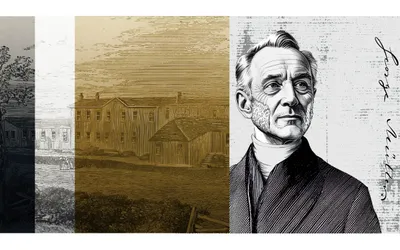

.png) George Müller
George Müller