

One of the great hindrances to a faithful life of prayer is unbelief. Not just unbelief regarding specific requests we make of the Lord via prayer, but a more general lack of belief that prayer is even effective or necessary. For Calvinistic believers, the question is: Why pray if God has already decided everything in advance? For believers who affirm some measure of human free will, the question could be: Why pray if people make their own decisions anyway?
As we continue to respond to the Holy Spirit's call to grow in our hidden life of the Word and prayer, we must tackle these kinds of questions head-on. We must take these thoughts captive and submit them to God's Word. Let's do that for a moment and explore something Paul wrote in his second letter to the Corinthians:
He has delivered us from such a deadly peril, and he will deliver us again. On him we have set our hope that he will continue to deliver us, as you help us by your prayers. Then many will give thanks on our behalf for the gracious favor granted us in answer to the prayers of many. (2 Corinthians 1:10-11)
"As you help us by your prayers." In saying this, Paul revealed his firm belief that prayer was effective. The Corinthians, although hundreds of miles away from Paul, were able to bring about changes to his circumstances by praying. He even went so far as to conclude that at his release people would give thanks to God, not because of God's sovereign choice to release Paul from prison, but rather "for the gracious favor granted us in the answer to the prayers of many."
What a joy, what an honor and what a privilege to know from our little "prayer closet" each day that we can affect events throughout the world through the power of God through prayer. Of course, there are Scriptural teachings that tell us we must allow the Scriptures to inform our prayers, but that is not what I want to focus on here. On the other hand, however, what a shame to know that many go without the help they would otherwise receive due to our prayerlessness.
James also highlights this reality in his letter, saying:
What causes fights and quarrels among you? Don’t they come from your desires that battle within you? You desire but do not have, so you kill. You covet but you cannot get what you want, so you quarrel and fight. You do not have because you do not ask God. When you ask, you do not receive, because you ask with wrong motives, that you may spend what you get on your pleasures. (James 4:1-3)
There is quite a bit we could unpack from this passage about why prayers are not answered and how that causes us to fight with our fellow believers, but I want to highlight just one: "You do not have because you do not ask God."
This is not an invitation to a name-it-and-claim-it prosperity gospel, but rather another reality of the effectiveness of prayer. We can actually lack things because we do not ask God for them. Scripture doesn't just say, "Well, God is sovereign, so you'll get what you need anyway." No, Scripture warns us, "You have not because you ask not."
C.S. Lewis addresses this principle in his book God in the Dock:
“Praying for particular things,” said I, “always seems to me like advising God how to run the world. Wouldn’t it be wiser to assume that He knows best?” “On the same principle,” said he, “I suppose you never ask a man next to you to pass the salt, because God knows best whether you ought to have salt or not. And I suppose you never take an umbrella, because God knows whether you ought to be wet or dry.” “That’s quite different,” I protested. “I don’t see why," he said. “The odd thing is that He should let us influence the course of events at all. But since He lets us do it in one way I don’t see why He shouldn’t let us do it in the other.” 1
How many days do we and our friends face temptations that we otherwise would not have faced because we did not ask the Lord, "Lead us not into temptation, but deliver us from the evil one"?
Now, perhaps it is correct that there are limitations to what we can ask the Lord for when it comes to human choice. Perhaps it is not appropriate to ask, "Father, make her stop sinning. Amen," or "Lord, make my mom become a Christian. Amen." These limitations (not of God's power but of His will) by no means infer that prayer is useless or pointless. We have powerful prayers to pray for others that will greatly impact them while still retaining their ability to choose: "Father, convict them of their sin. Amen," and "God, reveal the Lord Jesus to them in a powerful way. Amen."
The Lord answers these prayers when prayed in faith, and even if those who are subsequently convicted of sin and have Jesus revealed to them harden their hearts and do not respond (as we see with the four soils parable), that does not mean the Lord did not answer prayer and that those answered prayers weren't real opportunities for them to respond to and know God.
Near the end of his letter, James says this:
The prayer of a righteous person is powerful and effective. Elijah was a human being, even as we are. He prayed earnestly that it would not rain, and it did not rain on the land for three and a half years. Again he prayed, and the heavens gave rain, and the earth produced its crops. (James 5:16-18)
The Word of God declares that "the prayer of a righteous person is powerful and effective." On one hand, this should motivate us to live in the righteousness of Christ, but more to our point here, we have to choose to believe the biblical declaration about prayer. If we trust our own doubts and philosophical issues with the concept of prayer more than the Word of God, then it will be a self-fulfilling problem, for "when you ask, you must believe and not doubt, because the one who doubts is like a wave of the sea, blown and tossed by the wind. That person should not expect to receive anything from the Lord. Such a person is double-minded and unstable in all they do" (James 1:6-8, emphasis added)
Let's believe the Word of God and dive deeper into the ministry of prayer.
FOOTNOTES
C.S. Lewis, God in the Dock (Grand Rapids, MI: Eerdsmans Publishing Company, 2014), 236.






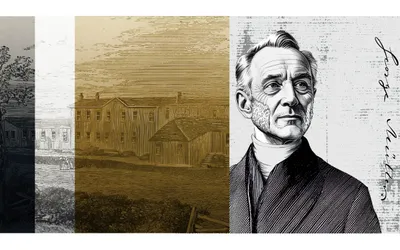

.png) George Müller
George Müller